 Real-IQ
The 5 Areas a Cognitive Test Measures: Why a Single IQ Number Misleads You
Discover the five distinct domains of human intelligence, why single-number IQ scores mask cognitive bottlenecks, and how to read your cognitive radar chart.
You probably know someone who can solve a hard math puzzle in ten seconds flat.
Yet that same person cannot follow three simple spoken steps without getting lost on the way out the door.
Or you might think of the sharp writer who puts words together with so much ease. Put that same person in front of a new spreadsheet, and their brain shuts down on the spot.
Both of these people might score a 120 on a standard test of intelligence.
On paper, their general score looks like it is the very same thing. In real life, they deal with very different daily struggles and strengths in all that they do.
A single test number hides what is really going on under the hood.
It mixes your fastest mental gears with your slowest points and calls it a day.
If you want to know how your mind really works, you have to break it down into five separate parts that tell the whole story.
The Flaw of the Single Number: The Cattell-Horn-Carroll Model
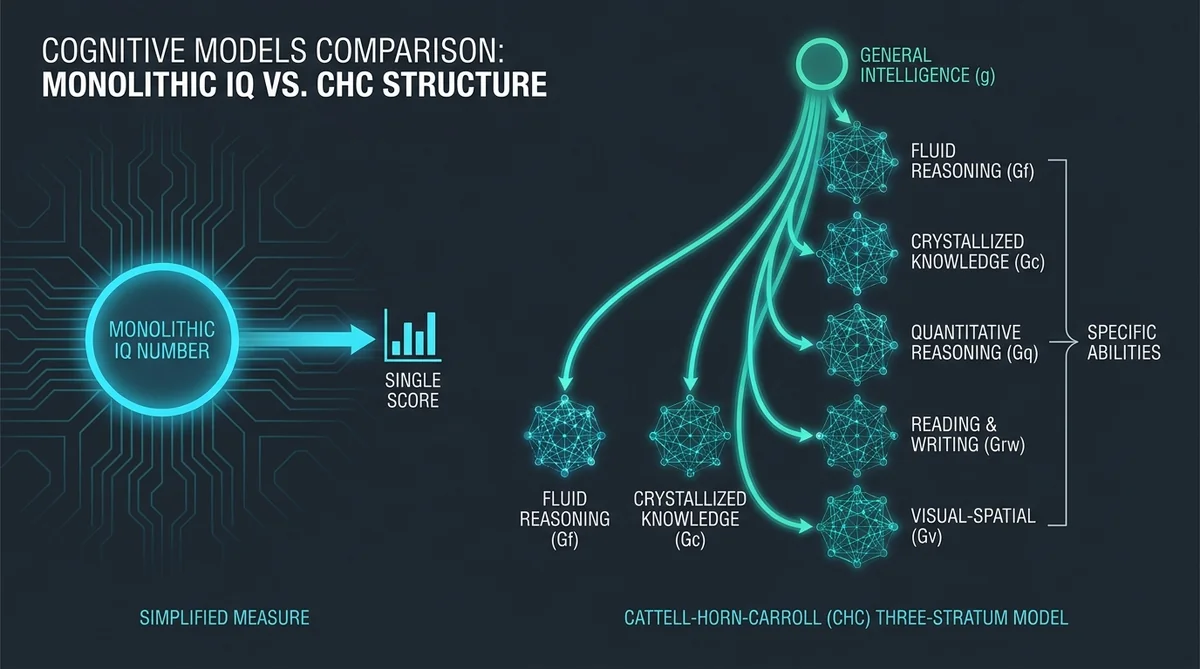
For more than fifty years, popular culture treated intelligence as if it were just one single score called *$g$*.
Modern science moved past that old view a long time ago for good reason.
In 1993, researcher John B. Carroll looked at more than four hundred data sets on how people think and solve problems. Carroll put his findings together with the earlier work of Raymond Cattell and John Horn.
Together, they built what we now know as the Cattell-Horn-Carroll model, or CHC theory.
The CHC model proves that your mind is not just one big engine that does it all.
It is a team of distinct tools working together at the same time. Each tool runs on its own neural network in the brain.
When you take a full clinical test like the WAIS-IV, psychologists do not just look at your top score and stop there.
They check the spread between your separate domain indexes to see what is going on.
A wide gap between two areas is often why very smart people hit a sudden wall in their work when they least expect it.
The 5 Core Cognitive Domains Explained
Every thorough test looks at five main areas of the mind to get a clear picture.
Here is how each area works in your brain and how it shows up in your day-to-day life.
### 1. Working Memory: The Mental Scratchpad
Working memory is the active RAM of your brain that keeps you on track.
It holds and shifts facts in real time while you work through a problem right in front of you.
This system sits in your dorsolateral prefrontal cortex, or DLPFC. It uses dopamine gates in the basal ganglia to let new facts in and keep out what you do not need.
As scientist Nelson Cowan showed in 2001, your working memory only holds about four chunks of data at any one time.
When you figure out a tip in your head at dinner, you use this system. You hold the bill amount in mind while you work out the share for each person and add the tax.
- Clinical Benchmark: WAIS-IV Digit Span and Letter-Number Sequencing.
- Daily Bottleneck When Low: You lose your place the moment someone talks to you. You struggle to carry out three verbal steps in a row without writing them down on paper.
### 2. Spatial Reasoning: The Mental 3D Engine
Spatial reasoning is your skill at picturing, turning, and moving shapes inside your mind without seeing them.
This domain relies on your parietal cortex and the visual pathways of your right hemisphere.
Engineers, pilots, builders, and designers rely on strong spatial skills every single day to do their jobs.
When you pack a full trunk for a trip or read a route on a map, your spatial circuits test the moves in your head before your hands touch anything.
- Clinical Benchmark: Corsi Block-Tapping Test and Shepard-Metzler Mental Rotation.
- Daily Bottleneck When Low: You have a hard time reading blueprints, putting furniture together from a diagram, or finding your way through a new building.
### 3. Processing Speed: The Neural Clock Rate
Processing speed is all about how fast your brain takes in visual cues, makes quick choices, and acts on them without delay.
It is not about deep logic or high intellect. It is the basic speed of your mental wires.
This area depends on the white matter tracts that link different parts of your brain together.
Thick myelin coats on your nerve fibers let electrical signals jump much faster from one point to another.
When your speed is high, simple tasks feel like they take no effort at all. That leaves more mental room for the hard problem-solving that matters most.
- Clinical Benchmark: Symbol Search and Coding tasks.
- Daily Bottleneck When Low: You feel wiped out after dealing with routine emails and paperwork. You feel like you are behind in fast team meetings where people throw out ideas at top speed.
### 4. Logical Deduction and Fluid Reasoning: Spotting Hidden Rules
Fluid reasoning ($Gf$) is your raw power to spot new patterns, grasp abstract rules, and solve fresh problems without relying on old facts you memorized in school.
It is the core of what most of us call analytical thinking.
This process lights up your central executive network across both your frontal and parietal lobes.
When you fix a bug in code or make sense of a sudden shift in market data, your brain pulls the underlying rule out of all the mess.
- Clinical Benchmark: [Raven Progressive Matrices](/quiz) and Matrix Reasoning.
- Daily Bottleneck When Low: You get stuck when familiar rules change without warning. You lean on memorized steps instead of figuring out new ways through a problem on your own.
### 5. Verbal Fluency: Word Retrieval and Rapid Framing
Verbal fluency measures how fast you pull facts from memory, find the right word, and turn abstract thoughts into clean speech that others can follow.
It runs on networks in your left temporal lobe, including Broca’s and Wernicke’s areas.
This is not just about having a big vocabulary full of rare words. It is about how quickly your brain can reach into its word bank under pressure.
High verbal fluency lets you explain hard ideas with clarity and handle live talks with confidence when it counts.
- Clinical Benchmark: Controlled Oral Word Association Test (COWAT) and Semantic Category Fluency.
- Daily Bottleneck When Low: You get that tip-of-the-tongue feeling all the time. You know what you want to say in your head, but the exact words will not come out when you try to speak.
The 5 Domains at a Glance
- Working Memory: Prefrontal Cortex (DLPFC). Standard Test: Digit Span / N-Back. Holds active facts and multi-step tasks in mind so you can work.
- Spatial Reasoning: Parietal Cortex. Standard Test: Mental Rotation / Corsi. Maps out 3D shapes, space, and system layouts in your head.
- Processing Speed: White Matter Tracks. Standard Test: Symbol Search / Choice RT. Scans visual data fast and powers routine tasks without drag.
- Logical Deduction: Frontoparietal Network. Standard Test: Raven Matrices. Finds hidden rules and solves new problems from first principles.
- Verbal Fluency: Left Temporal / Broca's. Standard Test: Category Fluency / COWAT. Pulls the right words fast and frames clear thoughts for others.
Why Spiky Profiles Beat Flat Averages
Most people think their mental power is the same across all five of these zones.
In the real world, almost everyone has what we call a spiky cognitive profile.
You will almost always have one or two areas that sit much higher or lower than the rest of what you do.
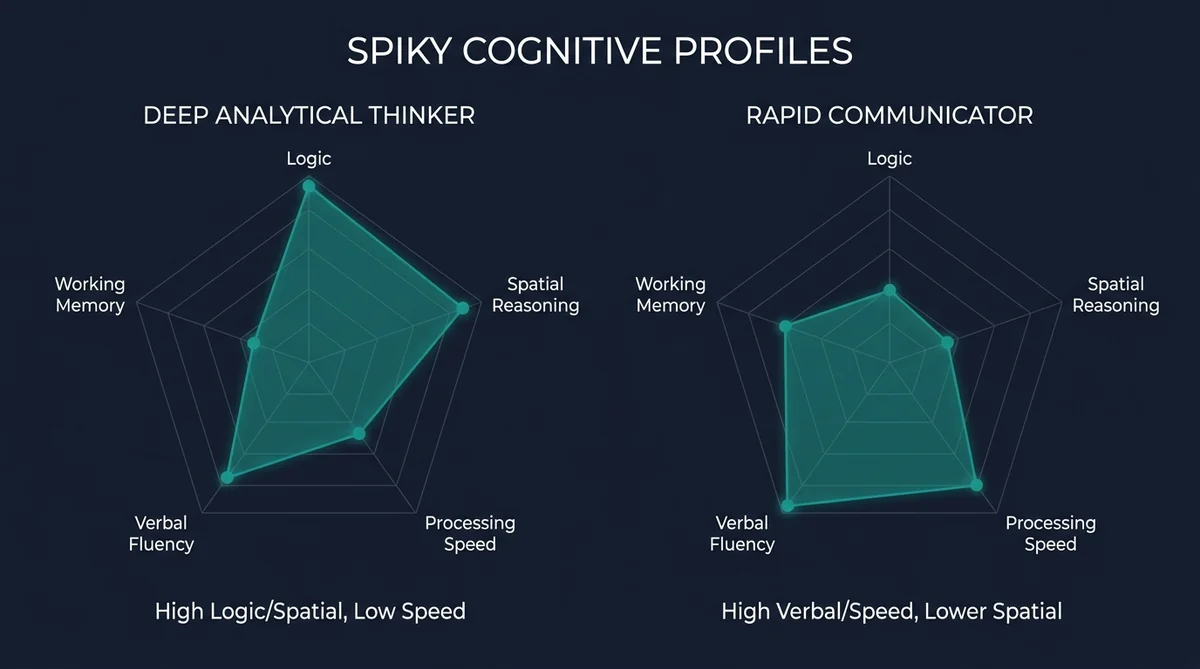
Here are two common profiles that show how this works in real life:
### Profile A: The Deep Analytical Thinker * Strengths: Top tier in Logical Deduction and Spatial Reasoning. * Bottlenecks: Lower range in Processing Speed and Working Memory. * How It Plays Out: This person builds great system designs or writes deep technical papers when left alone for hours at a time. But put them in a noisy room with constant pings and quick deadlines, and their focus falls apart in a hurry.
### Profile B: The Rapid Communicator * Strengths: Top tier in Verbal Fluency and Processing Speed. * Bottlenecks: Lower range in Spatial Reasoning and Fluid Logic. * How It Plays Out: This person shines in live client talks, team debates, and fast business decisions on the fly. But they struggle when they have to sit with a dense abstract data model that takes hours of slow, quiet deduction all by itself.
When you know your own shape, you can change how you set up your day from start to finish.
You stop beating yourself up over the wrong things in your workflow. You start building habits that protect your weak spots and make the most of your strengths every single day.
How to Map Your Cognitive Baseline
Taking a one-number test might flatter your ego for a day, but it gives you nothing you can actually use to get better.
If you want to sharpen your mind, you need to see your full score across all five of these areas.
When you look at your results on a clear radar chart, three big things happen right away: 1. You spot the natural strengths that give you an edge in your career that you can lean on. 2. You find the hidden bottlenecks that drain your energy before you even get to lunch. 3. You see the exact mental drills that will give you the biggest return on your time and effort.
You can check your baseline with the free 5-area cognitive profile on Real-IQ. The test covers all five core domains and gives you your own interactive radar map in just a few minutes so you can see where you stand.
Ready to test your own cognitive profile? Start the test
Keep reading
Educational and entertainment content. Nothing here is medical, psychological or employment advice, and no online test is a clinical assessment.